THE COSMIC COLLECTION · VESTA METEORITE

Fragment of a Minor Planet

Fragment of a Minor Planet

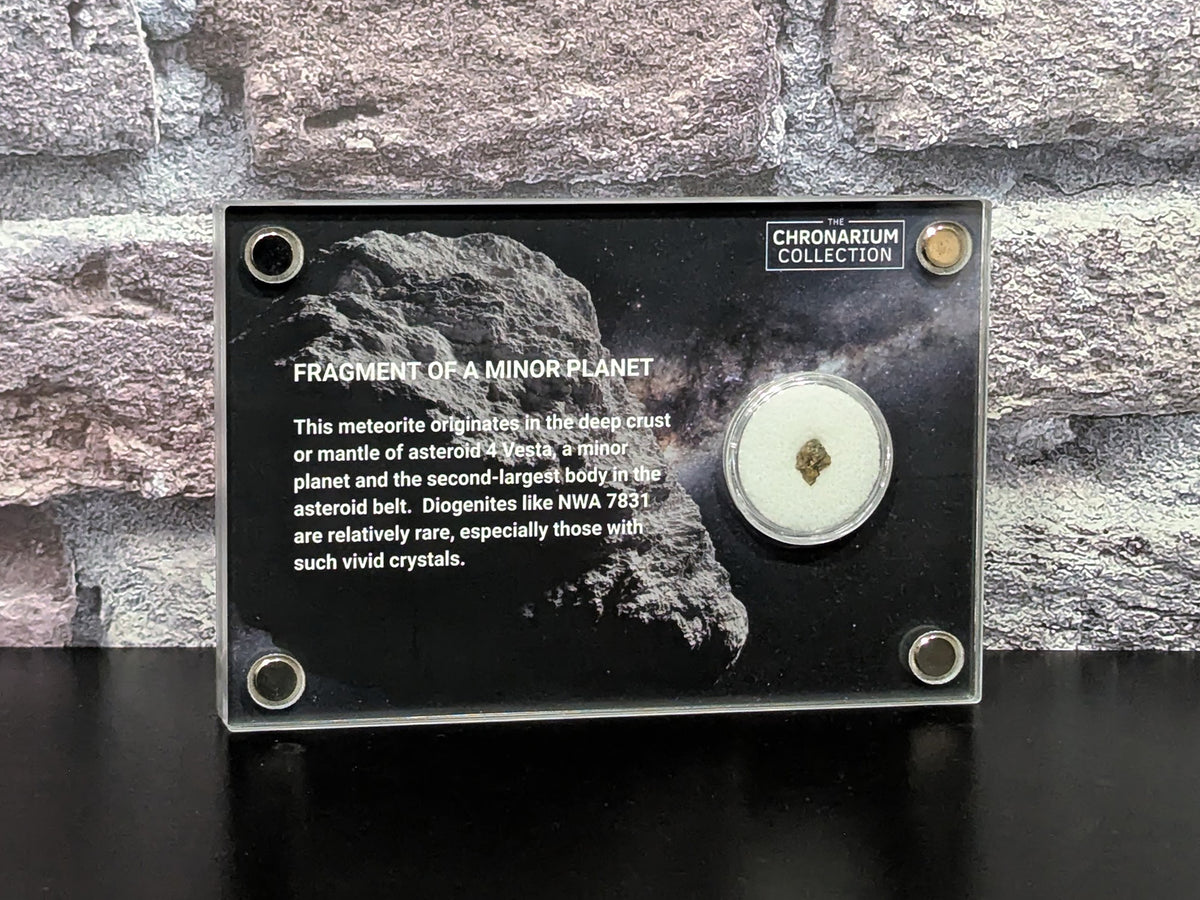
Hold a fragment of a differentiated protoplanetary crust: Asteroid 4 Vesta.

Regular price $69.00
Regular price Sale price $69.00
Sale Sold out
Shipping calculated at checkout.

THE COMPLETE GIFT

  • Diogenite meteorite fragment
  • Freestanding acrylic display
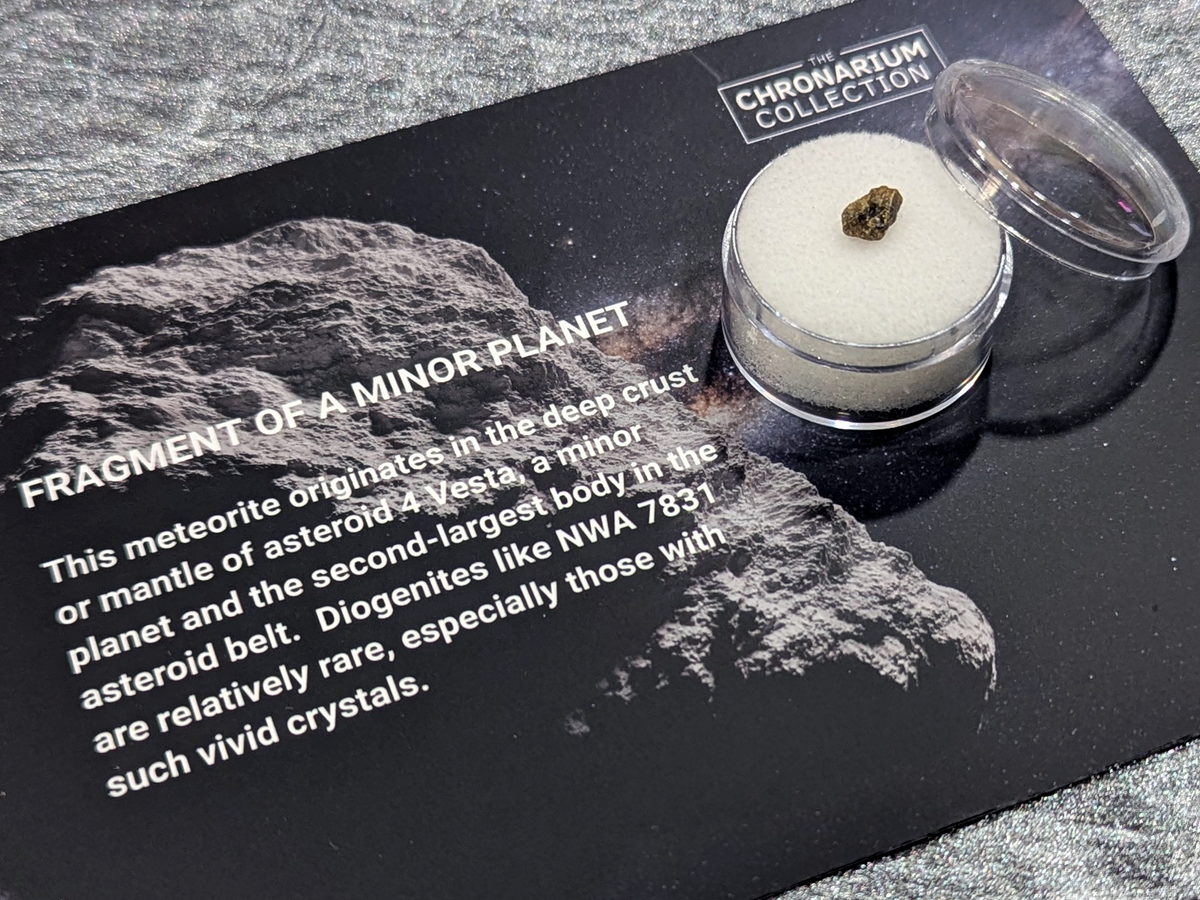
  • Specimen jar
  • Certificate of authenticity
  • Black cotton-padded gift box
Read the full specimen description

4 Vesta Meteorite (Diogenite)
A piece of the deep crust of a minor planet in the asteroid belt

Hold a fragment of a differentiated protoplanetary crust. This specimen is a diogenite-class meteorite: rock that formed deep within the crust of the asteroid 4 Vesta during the early formation of the Solar System. 4 Vesta is a minor planet, the second-largest asteroid, and one of the largest objects in the asteroid belt. Diogenites are part of the HED meteorite group (howardites, eucrites, diogenites) whose compositions match surface materials measured at 4 Vesta, linking these meteorites directly to that world.

Why diogenites matter
Diogenites are thought to be cumulate igneous rocks — coarse-grained orthopyroxene crystals that crystallized from magma and settled in the lower crust of 4 Vesta. Because they formed beneath the surface, diogenites provide one of the best windows into the internal geology and magmatic history of a small, once-molten world. 

Scientific context
Data from NASA’s Dawn mission (and laboratory studies) tie the HED meteorites to specific regions of Vesta — large impact events excavated crustal layers and sent fragments into space, some of which eventually reached Earth. Radiometric ages for HED meteorites place their crystallization very early in Solar System history (approximately 4.4–4.55 billion years ago), making them among the oldest igneous rocks available for study. 

Display & collecting notes
This specimen is a genuine diogenite-type achondrite — a collector’s example of planetary magmatism. Handle with care and avoid prolonged exposure to humid conditions to preserve any fusion crust and fresh surfaces.

View full details

THE COSMIC COLLECTION · VESTA METEORITE

A small world with a deep history.

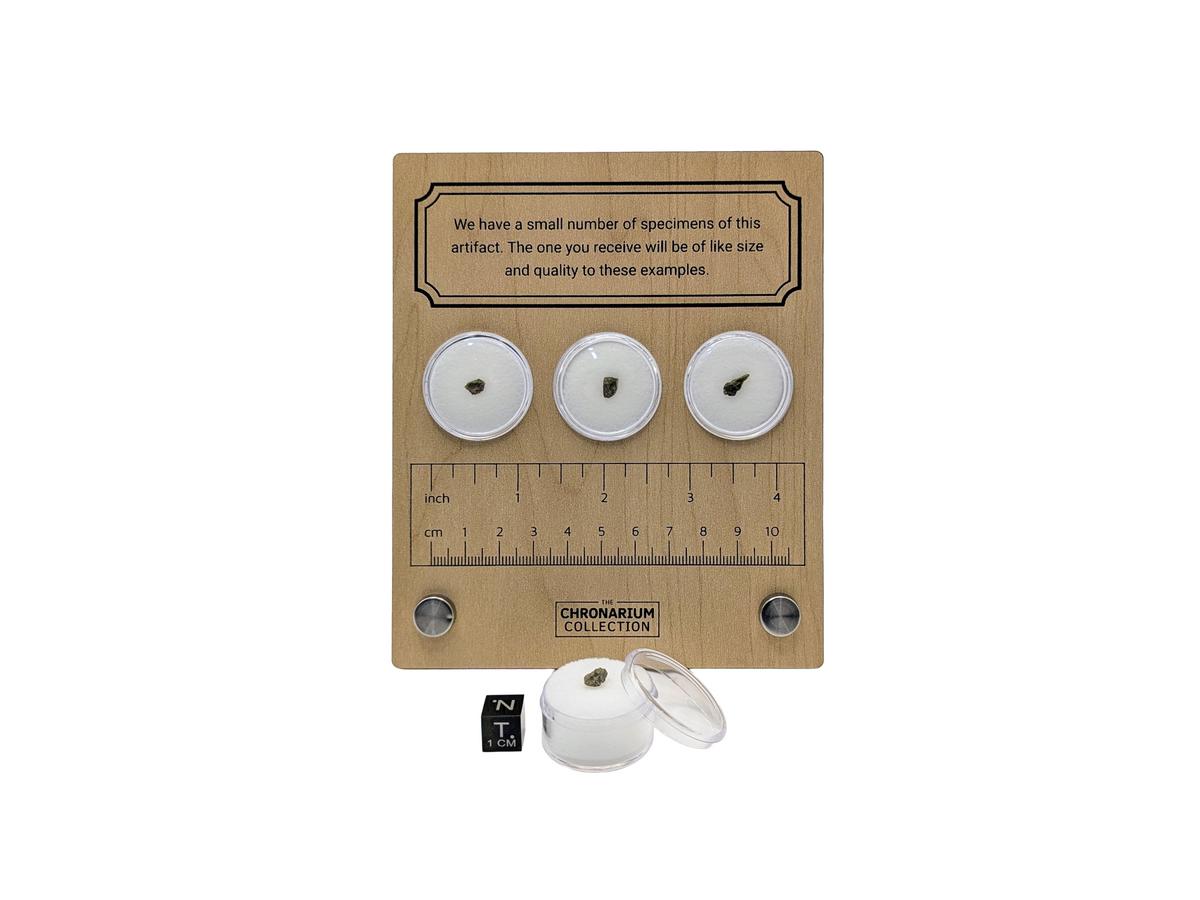
NWA 7831 is a diogenite rich in yellow-green orthopyroxene crystals, found in Western Sahara in 2013. Diogenites belong to the HED meteorite family associated with asteroid 4 Vesta, offering a tangible connection to a small world’s igneous history.

Meteorite facts & classification

Meteorite: Northwest Africa 7831 (NWA 7831)
Classification: Diogenite · HED achondrite
Found: 3 March 2013 · Saguia el Hamra, Western Sahara
Associated parent body: 4 Vesta
Discovery: Find

Authenticity & documentation

Scientific identification. The Bulletin credits classification to A. Irving and S. Kuehner (University of Washington), with oxygen-isotope analysis by K. Ziegler (University of New Mexico). A reference specimen is held at the University of Washington’s Burke Museum.

Read the NWA 7831 Meteoritical Bulletin entry ↗

NASA’s Dawn mission linked the HED meteorite family to Vesta. Read NASA’s explanation ↗

Our specimen. Acquired from an established specialist dealer offering an authenticity guarantee. Your display includes a Chronarium Collection Certificate of Authenticity.

The Bulletin records the named meteorite’s classification; supplier identification supports the attribution of the fragment offered here.

How Chronarium supports authenticity

A PLACE IN THEIR COLLECTION

A story, ready to display.

Each display contains a unique, authentic specimen in a removable jar, so you can take it out of the display for a closer look. The freestanding acrylic display includes a certificate of authenticity and a black cotton-padded gift box.

Included with this display

  • Authentic specimen in removable jar
  • Freestanding acrylic display
  • Certificate of authenticity
  • Black cotton-padded gift box
  • Authentic artifacts

    Sourced from established collectors and auctions, we ensure the authenticity of the specimens we sell.

  • History you can touch

    Each specimen is presented in a clear display jar, allowing you to examine it up close whenever curiosity strikes.

  • Hand-crafted displays

    Assemble your home museum with our freestanding displays, designed and crafted for each artifact in North Carolina, USA.